$68.17
$101.57
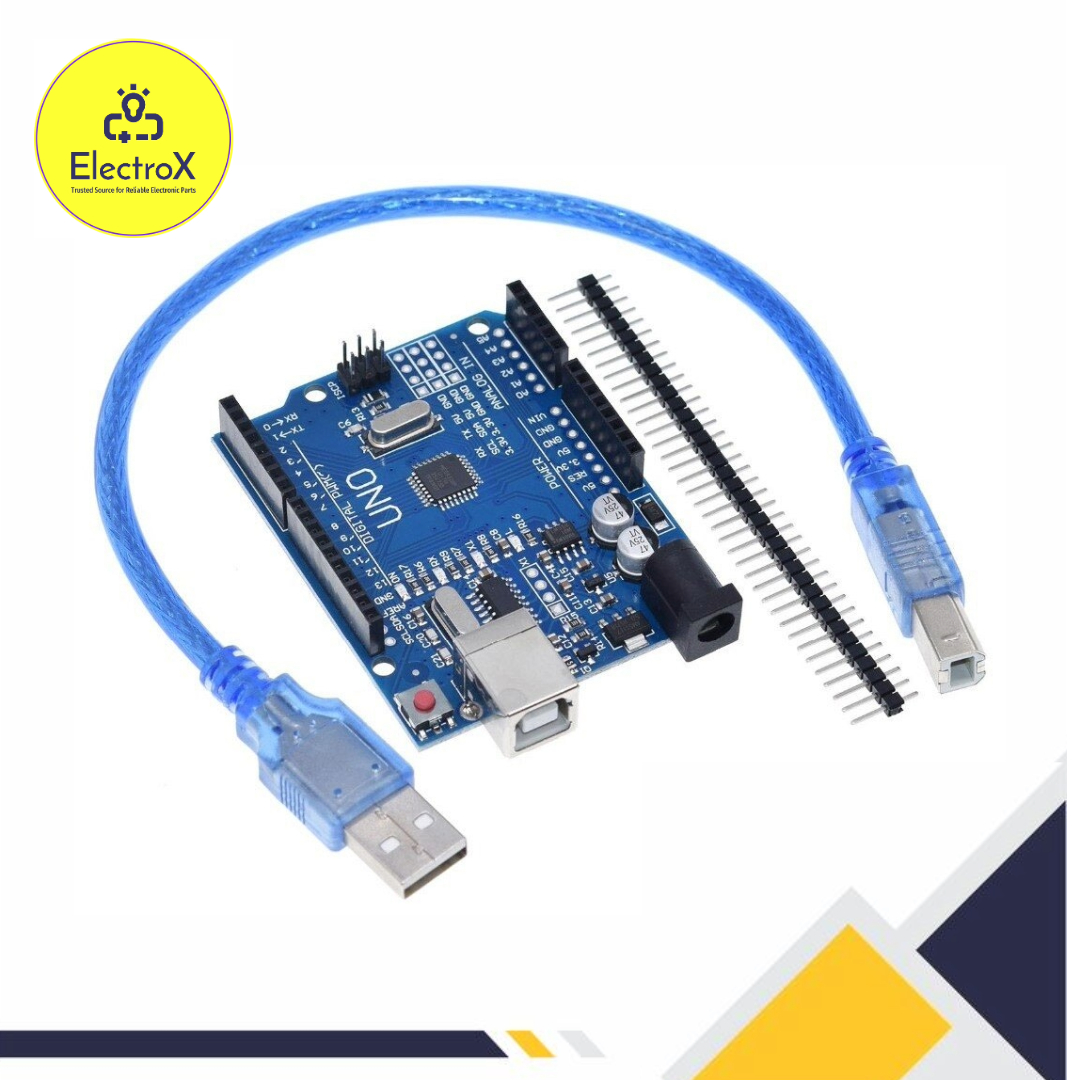
Table of Contents Toggle1. Overview of Arduino Uno R32. Microcontroller3. Power Supply4. Input and Output5. Communication6. Programming7. Shields and Expansion8. Applications9. Community and SupportThe Arduino Uno R3 is a widely recognized and used microcontroller board in the world of electronics and DIY projects. Known for its simplicity, flexibility, and open-source nature, the Arduino Uno R3 is popular among beginners, educators, and professionals alike. It serves as the backbone for a wide array of projects, from simple LED blinkers to complex robotics.1. Overview of Arduino Uno R3The Arduino Uno R3 is based on the ATmega328P microcontroller, an 8-bit AVR microcontroller that operates at a clock speed of 16 MHz. The board features 14 digital input/output pins, 6 analog input pins, a USB connection, a power jack, an ICSP header, and a reset button. The “R3” stands for “Revision 3,” which is the latest version of the Arduino Uno, featuring several updates from previous models, including additional pinouts and improved USB communication.2. MicrocontrollerAt the heart of the Arduino Uno R3 is the ATmega328P microcontroller. This chip is responsible for executing the code uploaded to the board and interacting with connected components like sensors, motors, and displays.Key Specifications of ATmega328P:Operating Voltage: 5VInput Voltage (recommended): 7-12VInput Voltage (limit): 6-20VDigital I/O Pins: 14 (6 provide PWM output)Analog Input Pins: 6DC Current per I/O Pin: 20 mAFlash Memory: 32 KB (of which 0.5 KB is used by the bootloader)SRAM: 2 KBEEPROM: 1 KBClock Speed: 16 MHz3. Power SupplyThe Arduino Uno R3 can be powered in several ways, making it versatile for various applications. It can draw power from the USB connection or from an external power supply such as an AC-to-DC adapter or battery.Power Input Options:USB Connection: Provides 5V directly from a computer or USB charger.Barrel Jack: Allows connection of an external power supply (recommended 7-12V).VIN Pin: An alternative way to power the board using an external voltage source.On-Board Power Regulation:5V Pin: Provides regulated 5V output for powering other components.3.3V Pin: Provides 3.3V for low-voltage components.GND Pins: Multiple ground pins are available for completing circuits.4. Input and OutputThe Arduino Uno R3 offers a versatile range of I/O options, making it easy to connect various sensors, actuators, and other components.Digital I/O Pins:Pins 0-13: Used for digital input or output, with each pin capable of reading or writing a HIGH or LOW state.PWM Pins: Pins 3, 5, 6, 9, 10, and 11 can be used for PWM output, simulating analog output by rapidly toggling between HIGH and LOW states.Analog Input Pins:Pins A0-A5: These pins can read an analog voltage between 0 and 5V, providing a 10-bit resolution, meaning the input voltage is converted into a value between 0 and 1023.Special Pins:TX/RX: Pins 0 and 1 are used for serial communication, transmitting (TX) and receiving (RX) data.Reset Pin: Can be used to reset the microcontroller.AREF Pin: Used to set an external reference voltage for the analog inputs.IOREF Pin: Provides the voltage reference for the microcontroller, which allows connected shields to adapt to the board’s voltage.5. CommunicationThe Arduino Uno R3 supports several communication protocols, enabling it to interact with various devices.Serial Communication:UART: The Arduino Uno uses pins 0 (RX) and 1 (TX) for serial communication with other devices or computers. This is the primary method for sending data to and receiving data from the board.I2C Communication:SDA/SCL Pins: I2C is a two-wire communication protocol used to communicate with multiple devices using just two pins (SDA for data, SCL for the clock).SPI Communication:MOSI, MISO, SCK Pins: SPI is a faster communication protocol typically used for high-speed data transfer, such as with SD cards or display modules.6. ProgrammingProgramming the Arduino Uno R3 is done using the Arduino IDE, a user-friendly and open-source software environment. The IDE supports various programming languages, primarily C/C , and simplifies the process of writing, uploading, and debugging code.Key Features of Arduino IDE:Sketches: Arduino programs are referred to as “sketches.” The IDE allows users to write and edit these sketches easily.Libraries: The Arduino ecosystem includes numerous libraries, pre-written code to control various hardware components like sensors, displays, and motors.Serial Monitor: The IDE provides a serial monitor that allows users to communicate with the Arduino board, sending and receiving data through the serial port.Uploading Code:Via USB: Connect the Arduino to your computer using a USB cable, select the correct board and port in the IDE, and click “Upload” to transfer the code to the board.Bootloader: The Uno R3 comes with a pre-installed bootloader, allowing for easy code uploads without the need for an external programmer. The bootloader takes up 0.5 KB of the 32 KB flash memory.7. Shields and ExpansionThe Arduino Uno R3 is designed to be expandable with shields, which are modular boards that fit on top of the Arduino and add functionality, such as wireless communication, motor control, or GPS tracking.Common Shields:Motor Shield: Controls DC motors and servos.Wi-Fi Shield: Adds wireless communication capabilities.Ethernet Shield: Enables network connectivity via Ethernet.LCD Shield: For adding display functionalities.Pin Compatibility:Stackable Headers: The Arduino Uno R3 features stackable headers, allowing multiple shields to be used simultaneously.8. ApplicationsThe Arduino Uno R3 is incredibly versatile, making it suitable for a wide range of applications across various domains.Common Applications:Prototyping: Ideal for testing and developing new ideas, allowing for quick iteration and debugging.Education: Widely used in classrooms to teach electronics, programming, and robotics.Home Automation: Used to control home appliances, lighting, and security systems.Robotics: Commonly used in robot design, controlling motors, sensors, and other components.Art Installations: Utilized in interactive art projects that involve lights, sound, and motion.9. Community and SupportOne of the biggest strengths of the Arduino Uno R3 is its large and active community. This community provides a wealth of resources, including tutorials, forums, and libraries that make it easier to learn and develop with Arduino.Online Resources:Arduino Website: Official documentation, tutorials, and forums.GitHub: Many open-source projects and libraries are available for Arduino.Instructables: A popular site where users share projects and step-by-step guides.YouTube: Numerous channels offer video tutorials and project ideas.Learning Resources:Books: There are many books dedicated to learning Arduino, ranging from beginner guides to advanced projects.Workshops: Many makerspaces and schools offer workshops to teach Arduino basics. Common Questions: What is the price of Arduino UNO R3 Original Made in Italy in Bangladesh? The latest price of Arduino UNO R3 Original Made in Italy in Bangladesh is 650BDT. Where to buy Arduino UNO R3 Original Made in Italy in Bangladesh? You can buy the Arduino UNO R3 Original Made in Italy at the best price from ElectroXBD in Bangladesh. Tutorial: Click Here
Arduino